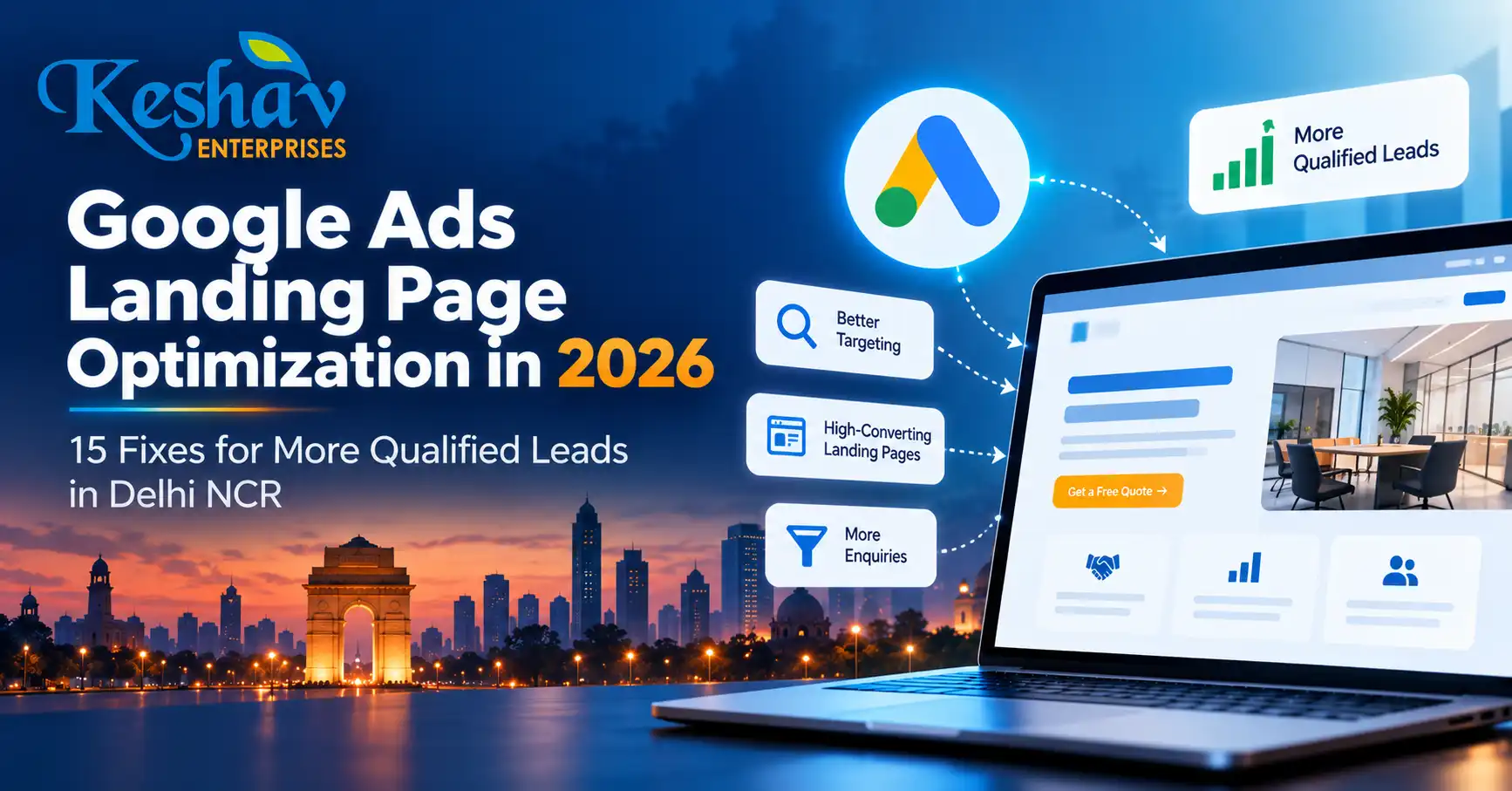
Google Ads landing page optimization means improving the page people see after clicking an ad so that it matches their search, explains the offer clearly and makes the next action easy. For a Delhi NCR service business, the best starting point is usually not another campaign or a larger budget. It is a focused page with a clear promise, useful proof, a working form or call option, reliable tracking and a fast mobile experience.
This practical 2026 guide covers 15 improvements you can make before increasing ad spend. It focuses on qualified leads, not just more form submissions. There is no guaranteed conversion rate: results depend on search intent, competition, offer quality, pricing, targeting, follow-up and the page itself.
Quick answer: how do you improve a Google Ads landing page?
Match the landing page headline to the ad’s promise, give visitors a clear reason to choose your service, remove distractions, show genuine trust signals, make contact easy on mobile, and measure which enquiries become customers. Google explicitly recommends aligning landing pages with ads and keywords, including the call to action. Read Google Ads’ landing page optimization guidance.
Why a landing page matters more than another design refresh
A search ad may attract someone who is ready to act, but that person still needs to verify that your business solves the exact problem. If an ad promises “Shopify store development in Delhi” and sends visitors to a generic homepage listing ten unrelated services, the visitor must work harder to find the relevant offer. A dedicated page can explain the service, scope, process and next step immediately.
Google’s ad-quality guidance emphasizes relevance to users’ searches and intentions, and the ability to complete tasks easily. It does not say that a prettier page or a higher bid automatically fixes poor relevance. See Google’s explanation of what matters for ad quality.
Landing page vs homepage: which should your ads use?
| Situation | Better destination | Reason |
|---|---|---|
| Specific service search | Dedicated service landing page | Answers the exact commercial question |
| Branded company search | Homepage or relevant company page | Supports broader brand evaluation |
| Time-limited promotion | Offer-specific page | Keeps the advertised terms visible |
| Multiple unrelated services | Separate pages by intent | Prevents a generic message from diluting relevance |
| Existing strong service page | Improve and test the existing page | A new page is not always necessary |
15 Google Ads landing page fixes that address real conversion problems
1. Match the headline to the search and ad
The first screen should confirm that visitors reached the right place. For an ad about “Google Ads management in Gurgaon,” a page headed “Full-Service Digital Solutions” is less specific than “Google Ads Management for Gurgaon Businesses.” Match the actual service and market without claiming a physical office in a location where you do not have one.
2. Make the offer understandable in one glance
Explain what you do, who it is for and what happens after an enquiry. A useful first-screen statement might be: “Google Ads campaign planning, landing-page improvement and conversion tracking for service businesses in Delhi NCR.” Avoid vague superlatives and promises such as guaranteed leads.
3. Use one primary conversion goal
A lead-generation page can offer a form, phone call and WhatsApp, but they should all support one clear outcome: an enquiry about the advertised service. If the page also pushes unrelated blogs, newsletters, app downloads and offers, the next step becomes confusing.
4. Show the primary CTA early
Use action-oriented labels such as “Request a PPC Audit,” “Discuss Your Campaign,” or “Get a Landing Page Review.” Match the CTA to what the visitor receives. Do not label a paid service as free unless that part of the offer genuinely is free.
5. Reduce form friction without losing lead quality
Ask only for the information needed to qualify and respond. For many B2B enquiries, name, business, contact method, service requirement and a short message are enough for the first step. Additional questions can be optional or collected later. Test form length against qualified lead rate, not raw submissions alone.
6. Make mobile actions easy to use
Check the page on an actual phone. Buttons should be easy to tap, text should be readable, the form should not jump around, and a sticky call button should not cover important information. Test with slow connections and common viewport sizes, not only a desktop browser preview.
7. Replace generic claims with verifiable proof
Useful proof includes a clear service process, genuine project examples, credentials that can be checked, real testimonials used with permission, and transparent contact information. Do not invent client names, rankings, revenue lifts or performance percentages.
8. Explain what is included and excluded
People searching for an agency often want to know whether the scope includes account setup, keyword research, ad copy, landing-page development, tracking, reporting and ongoing optimization. Make deliverables explicit. If media spend is separate from management fees, say so.
9. Address price questions without manufacturing a fixed price
If pricing depends on account complexity, target locations, campaign volume, creative needs or integration requirements, explain those factors. A clear quotation process is more credible than a fabricated “starting at” price.
10. Improve speed without sacrificing clarity
Compress large images, avoid unnecessary scripts, load essential content promptly and check whether popups or animations interfere with the form. Use real-user performance data where available. Page speed matters for usability, but it is not a substitute for a relevant offer.
11. Keep the navigation focused
Removing every navigation link is not automatically the best choice. For a complex B2B service, some visitors may need to verify the agency, review its process or inspect contact details. Keep a clear path to trust information while minimizing irrelevant exits.
12. Create service- and location-specific relevance only when genuine
A campaign for Delhi, Noida or Gurgaon can use locally relevant language, service examples and contact expectations. Avoid duplicating the same page across dozens of city slugs with only the location swapped. If a page targets several NCR areas, one strong page may be more useful than many thin copies.
13. Check conversion tracking from start to finish
Verify that a real successful form submission, completed call action or agreed lead event triggers the intended conversion. Do not count every button click as a qualified lead. Test duplicate submissions, thank-you page behavior, spam handling and CRM delivery. Ensure tracking respects consent and privacy requirements.
14. Connect lead data to sales outcomes
A campaign can produce many enquiries that never fit the business. Record lead source, campaign, landing page, service interest and qualification outcome where lawful and appropriate. Compare cost per qualified lead and eventual sales, not only cost per form submission.
15. Test one meaningful hypothesis at a time
Examples include changing the headline to match the ad more closely, simplifying the form, moving proof near the CTA, or improving mobile layout. Define the success metric before the test. Avoid declaring a winner from a tiny sample or changing many elements simultaneously without a controlled plan.
A practical landing page structure for service businesses
A strong page does not need to be crowded with cards. The following structure gives visitors the information they usually need in a natural sequence:
- Hero: service-specific headline, short explanation, primary CTA and one genuine proof element.
- Problem and fit: the situations your service solves and who it is suitable for.
- Scope: clear deliverables, process and important exclusions.
- Evidence: real work examples, team qualifications or documented methodology.
- Practical questions: timeline, pricing factors, access required and reporting.
- Conversion section: simple form or contact option with clear follow-up expectations.
For design implementation, see Keshav Enterprises’ UI/UX design services. The aim is to make a useful decision easy, not to maximize visual effects.
Example: improving a Delhi NCR Google Ads landing page
Imagine a company advertising a website development service. Its ad says “Business Website Development in Delhi NCR,” but its destination page opens with “Welcome to Our Digital Universe,” a large animation and a generic “Learn More” button. The enquiry form is several screens below.
A practical rewrite could use the heading “Business Website Development for Delhi NCR Companies,” explain supported platforms and deliverables, show a short project process, offer a clear quotation CTA and move the enquiry form closer to the decision content. This is an illustrative scenario, not a claimed client case study or measured result.
What should you measure after improving the page?
| Metric | What it tells you | Important limitation |
|---|---|---|
| Landing-page conversion rate | Share of visitors completing the tracked action | Can be inflated by low-quality leads |
| Cost per lead | Ad spend divided by tracked leads | Not a measure of sales quality |
| Cost per qualified lead | Ad spend divided by leads meeting your criteria | Requires consistent qualification rules |
| Form completion rate | How often form starters finish | May improve while lead quality declines |
| Call and WhatsApp enquiries | Alternative contact paths | Needs careful attribution and privacy handling |
| Lead-to-sale rate | Whether enquiries become customers | May have a long sales cycle |
Example calculation: if a campaign spends ₹20,000 and produces 20 verified qualified leads, the cost per qualified lead is ₹1,000. These figures are hypothetical and are not Keshav Enterprises performance claims.
When should you redesign the page instead of editing it?
Start with a focused improvement when the current page has a clear offer, functional tracking and a usable mobile layout. Consider a larger redesign if the page architecture prevents clear service information, the form is unreliable, mobile navigation is broken, or essential changes cannot be made without rebuilding the template.
If the broader question is whether to invest in organic growth or paid search, read our SEO vs Google Ads comparison for Delhi NCR businesses. This article instead focuses specifically on what happens after the ad click.
30-day Google Ads landing page improvement plan
Week 1: audit and baseline
Review search terms, ad messages, landing-page variants, mobile behavior, conversion definitions and lead quality. Record the starting performance without inventing benchmarks.
Week 2: fix clarity and friction
Rewrite the headline, clarify scope, improve the CTA, simplify forms, strengthen trust information and test on mobile devices.
Week 3: verify tracking and launch controlled tests
Check conversion events end to end. Run a focused comparison with a defined hypothesis, sufficient observation and clear success metrics.
Week 4: review qualified outcomes
Compare enquiry quality and acquisition cost, document what changed and prioritize the next improvement. The four-week sequence is a planning example, not a guaranteed result timeline.
Frequently asked questions
What is Google Ads landing page optimization?
It is the process of making the page reached from an ad more relevant, easier to use and better at generating the intended business outcome. Typical work includes message matching, UX, forms, trust, speed and tracking.
Does Google Ads need a separate landing page?
Not always. A strong service page can be a suitable destination. A dedicated page is useful when the ad targets a specific offer, audience or location that a general page does not address clearly.
Can a better landing page reduce wasted ad spend?
It can help visitors understand the offer and complete the intended action, but savings are not guaranteed. Targeting, bids, competition and follow-up still matter.
What is landing page experience in Google Ads?
It is part of Google’s assessment of how relevant and useful the destination is for people clicking an ad. The exact assessment is determined by Google, not by an agency’s self-reported score.
Should I remove navigation from a PPC landing page?
Not automatically. Reduce distracting choices, but keep enough information and links for visitors to evaluate trust, policies and the business itself.
How many fields should a lead form have?
Use the minimum needed for a useful response and qualification. Test form friction against lead quality rather than applying a universal field count.
Does landing page speed affect Google Ads results?
Slow or unstable pages can make it harder for visitors to act. Improving usability and relevance is useful, but speed alone cannot compensate for weak targeting or an unclear offer.
Should Delhi and Gurgaon campaigns use different landing pages?
Only when there is a meaningful difference in offer, service availability, proof or audience needs. Thin duplicated city pages are not a good long-term strategy.
Can AI write my landing page copy?
AI can assist with drafts and alternatives, but a person should verify service claims, pricing, proof, legal wording and alignment with the actual offer.
How do I know whether a landing page is working?
Track verified conversion actions, qualified lead volume, cost per qualified lead and sales outcomes. Review them alongside search terms and the page’s mobile usability.
Final takeaway
The best Google Ads landing page is the one that answers the visitor’s exact question and makes the right next step easy. Start with message match, mobile usability, proof, forms and tracking before paying for more traffic. Avoid unverified promises, misleading local claims and decorative complexity that does not help users.
Keshav Enterprises supports Google Ads and PPC campaign management alongside landing-page planning for Delhi NCR businesses. If you need a practical review of an existing campaign and its destination page, share your website and requirement.