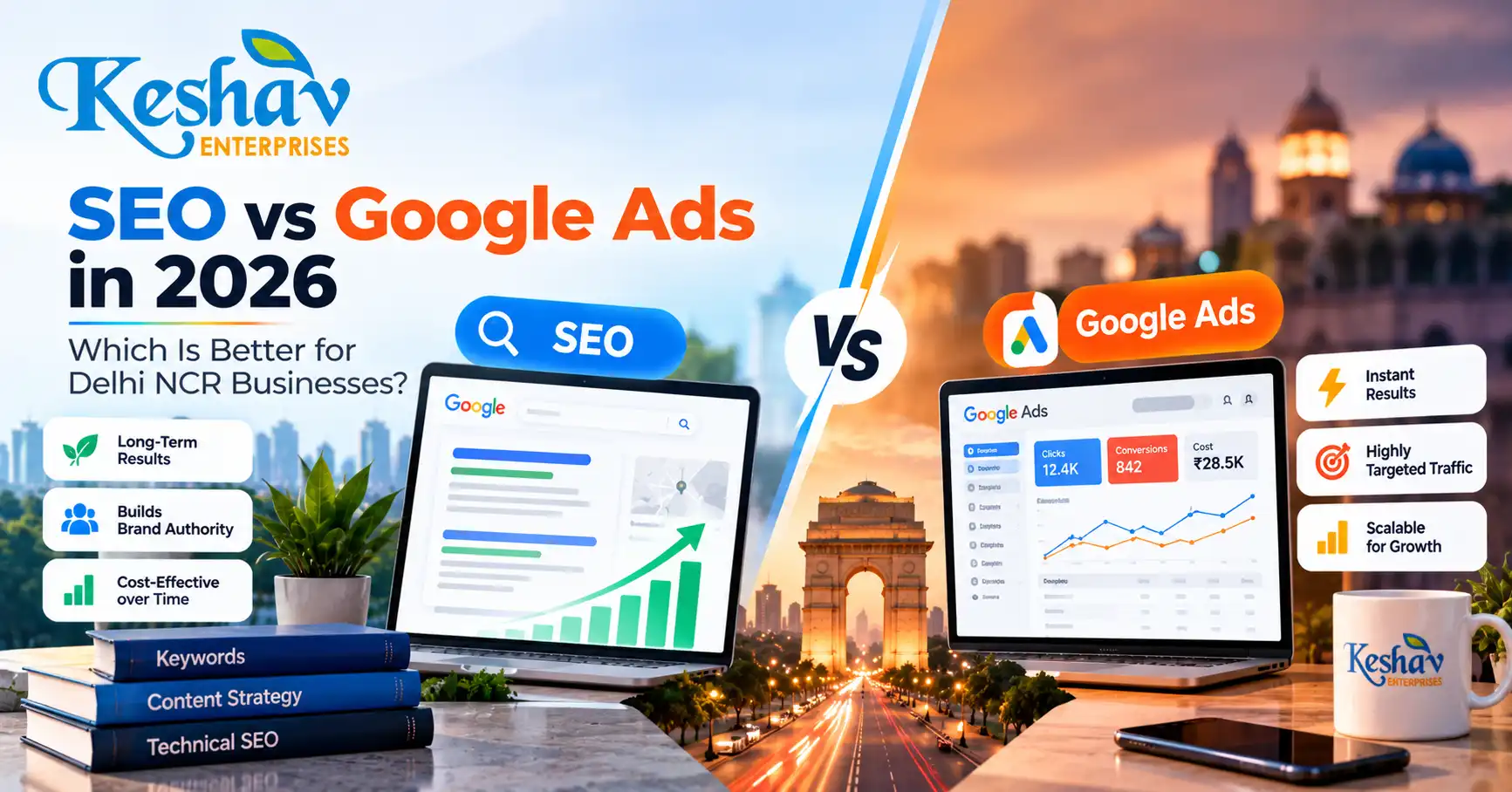
SEO and Google Ads solve different growth problems. For most businesses in Delhi NCR, SEO is better for building compounding organic visibility over time, while Google Ads is better for generating controlled visibility quickly when people are already searching for a service. The strongest strategy is often not choosing one forever, but using each channel where it has the clearest commercial role.
This guide compares SEO vs Google Ads in 2026 for businesses in Delhi, Noida, Gurgaon, Ghaziabad and nearby NCR markets. It focuses on lead quality, speed, cost behaviour, trust, local search, measurement and the type of website needed to convert traffic into enquiries.
Quick answer: SEO or Google Ads — which is better?
If you need leads quickly, want to test an offer or need visibility for competitive commercial searches, Google Ads management in Delhi NCR can create immediate exposure once campaigns are approved and active.
If you want to reduce long-term dependence on paid clicks and build a stronger search presence across service pages, local searches and informational topics, SEO services in Delhi NCR are the better long-term foundation.
For many established businesses, the practical answer is SEO + Google Ads together: use paid search to capture demand now, while SEO builds the organic assets that can keep generating visibility over time.
SEO vs Google Ads: side-by-side comparison
| Factor | SEO | Google Ads |
|---|---|---|
| Speed | Usually gradual; growth compounds with technical, content and authority improvements. | Can generate visibility quickly after campaign setup and approval. |
| Traffic cost | No fee per organic click, but strategy, content, technical work and authority building require investment. | You pay for ad traffic and need active campaign management. |
| Best use | Long-term discovery, authority, local visibility and broad topic coverage. | Immediate demand capture, offer testing, lead generation and time-sensitive campaigns. |
| Control | Lower direct control over ranking positions and timelines. | Higher control over keywords, locations, budgets, schedules and landing pages. |
| Compounding value | Strong pages can continue earning visibility after they are published and improved. | Traffic normally reduces when campaigns stop spending. |
| Measurement | Track impressions, clicks, rankings, engagement, leads and assisted conversions. | Track spend, clicks, conversions, cost per lead, search terms and campaign performance. |
| Local targeting | Strong for organic local pages, Google Maps support and location relevance. | Strong for defined geographic targeting and high-intent local searches. |
What does SEO actually do for a business?
Search engine optimization improves the technical accessibility, relevance, usefulness and authority of a website so it can earn greater visibility for appropriate searches. Good SEO is not limited to adding keywords to a page.
A practical SEO programme can include technical auditing, keyword and search-intent mapping, service-page improvement, internal linking, local SEO, content publishing, structured data, image optimization, crawl/indexation fixes and authority development.
For a service business in Delhi NCR, SEO can help build visibility for searches such as:
- SEO company in Delhi
- website development company in Delhi NCR
- Shopify developer in Noida
- Google Ads agency in Gurgaon
- digital marketing agency near me
- Problem-based searches such as “why is my website not ranking?”
SEO also supports answer engines and AI-driven discovery when pages are written with clear definitions, useful comparisons, direct answers, consistent business information and strong topic relationships. That is one reason we recommend building content for real user questions rather than repeating one keyword unnaturally.
What does Google Ads actually do?
Google Ads allows a business to appear for selected search demand through paid campaigns. A campaign can be structured around keywords, locations, audiences, devices, schedules, budgets and conversion goals.
The advantage is speed and control. If someone is actively searching for a service, a well-built search campaign can place the offer in front of that person without waiting for an organic page to improve its ranking.
However, paid traffic does not fix a weak offer or a weak website. If users click an ad and reach a slow, confusing or generic page, the business may pay for traffic without generating enough qualified enquiries. That is why our website development work and PPC planning are connected to landing-page clarity, mobile experience, tracking and conversion paths.
Which channel generates leads faster?
Google Ads is normally the faster channel for immediate search visibility. Once the account, campaign, targeting, ads, landing page and tracking are ready, the business can start entering paid auctions for relevant searches.
SEO is generally slower because search engines need to crawl, understand, evaluate and re-evaluate website changes. Competitive searches may require stronger content, technical fixes, internal linking, local relevance and authority before meaningful organic growth appears.
This does not make SEO weak. It means SEO and PPC operate on different timelines.
Which channel is cheaper?
There is no universal answer. SEO does not charge per click, but useful SEO still requires investment in strategy, content, technical implementation, reporting and sometimes development. Google Ads charges for ad traffic, and competitive sectors can require meaningful budgets to collect enough data and conversions.
The better question is: which channel produces qualified enquiries at an acceptable acquisition cost? A low-cost click that never becomes a lead is not necessarily better than a more expensive click that produces a valuable enquiry.
Which is better for trust and credibility?
Organic visibility can support credibility because users repeatedly encounter a business across service pages, local results, helpful articles and branded searches. Paid ads can also create trust when the landing page is specific, transparent and professionally built.
Trust is not created by the traffic source alone. It comes from the complete experience: clear positioning, real contact information, relevant services, useful content, strong mobile UX, transparent calls to action and consistent business information.
SEO vs Google Ads for local businesses in Delhi NCR
Local competition varies significantly across Delhi, Noida, Gurgaon, Ghaziabad and other NCR areas. A business may rank well in one area and poorly in another because local results depend on relevance, distance, prominence and the searcher’s context.
For local visibility, SEO should connect the website with accurate business information, strong service pages, genuine local relevance, useful location content and a correctly managed Google Business Profile. Our detailed local SEO guide for Delhi businesses explains this process in more depth.
Google Ads can complement that strategy by targeting high-intent searches in defined service areas while organic visibility grows.
When should a business choose SEO first?
SEO is often the better first priority when:
- Your website has weak or inconsistent organic visibility.
- You have several services that need dedicated search-ready pages.
- Your buyers research extensively before contacting a provider.
- You want to build long-term topical authority.
- You depend too heavily on paid traffic.
- You want stronger local and organic discovery across Delhi NCR.
- Your site has technical SEO or indexation problems.
- You already receive enquiries but want more sustainable inbound demand.
When should a business choose Google Ads first?
Google Ads can be the better first priority when:
- You need demand quickly for an active service or offer.
- You want to validate which search terms generate real enquiries.
- You are entering a new market and do not yet have strong organic rankings.
- You have a focused landing page and reliable lead follow-up.
- You need geographic control across Delhi, Noida, Gurgaon or another service area.
- You want to measure cost per lead for specific commercial queries.
- You are running a time-sensitive launch, promotion or campaign.
When should SEO and Google Ads run together?
Running both channels together makes sense when a business has enough budget and operational capacity to handle incoming leads.
A combined strategy can work like this:
- Google Ads captures immediate demand. Campaigns target high-intent searches and reveal useful search-term and conversion data.
- SEO builds long-term assets. Strong service pages, local pages, technical improvements and useful articles expand organic visibility.
- Landing pages improve both channels. Better message clarity, speed, forms and proof can improve paid conversion rates while also strengthening organic usefulness.
- Search data informs content. Real query patterns can reveal customer language and new content opportunities.
- Brand visibility becomes more resilient. The business is not dependent on only one traffic source.
A practical 90-day SEO + Google Ads framework
Days 1–30: fix tracking and foundations
- Audit the website, analytics and conversion tracking.
- Identify high-value services and target locations.
- Map commercial search intent to the correct landing pages.
- Fix technical issues that block crawling, indexing or conversion.
- Build or improve the highest-priority PPC landing page.
- Launch tightly controlled paid search campaigns where appropriate.
Days 31–60: improve relevance and conversion
- Upgrade core service-page content.
- Improve titles, headings, internal links and FAQs.
- Review Google Ads search terms and exclude irrelevant traffic.
- Test landing-page messaging and calls to action.
- Publish one or more supporting articles around real buying questions.
- Strengthen local SEO signals if location-based demand matters.
Days 61–90: scale what is working
- Compare lead quality by campaign, keyword and landing page.
- Expand organic content around validated customer questions.
- Improve pages that receive impressions but weak clicks or conversions.
- Adjust PPC budget toward better-performing intent clusters.
- Develop relevant authority and local mentions.
- Review the full journey from search to enquiry, not only traffic.
How to make your content easier for Google, AI search and LLM systems to understand
There is no special “LLM keyword” that guarantees citation or ranking in AI answers. The safer approach is to make the website easy to interpret and trustworthy.
- Answer the main question directly near the top of the page.
- Use descriptive headings based on real user questions.
- Explain important terms in simple language.
- Use comparison tables where they genuinely help.
- Keep business name, services, location and contact details consistent.
- Add visible FAQs that answer practical buying questions.
- Use relevant internal links between related services and guides.
- Keep claims specific and avoid unsupported guarantees.
- Use structured data only when it accurately represents visible content.
- Update important pages when services, pricing models or business details change.
This approach supports SEO, AEO (Answer Engine Optimization), GEO and LLM discoverability without sacrificing usefulness for human visitors.
What should Delhi NCR businesses measure?
Whether you use SEO, Google Ads or both, measure business outcomes rather than vanity metrics.
- Qualified form submissions.
- Calls and WhatsApp enquiries where tracked.
- Conversion rate by landing page.
- Organic clicks to commercial pages.
- Search terms that generate qualified leads.
- Cost per qualified lead from paid campaigns.
- Location-level visibility for target services.
- Lead-to-sale quality, not only raw lead count.
Frequently asked questions
Is SEO better than Google Ads?
SEO is better for building compounding organic visibility over time, while Google Ads is better for immediate controlled visibility. The best choice depends on your timeline, budget, website quality, competition and business objective.
How long does SEO take to work?
There is no fixed timeline. Technical improvements may be reflected relatively quickly, while competitive commercial rankings can require sustained work over several months. The starting condition of the website, competition, content quality and authority all affect the timeline.
How quickly can Google Ads generate leads?
Google Ads can start generating visibility after campaign setup and approval, but lead quality depends on targeting, search terms, bidding, ad relevance, landing-page quality, tracking and follow-up. Fast traffic does not automatically mean profitable traffic.
Should a small business in Delhi run SEO or PPC?
A small business should choose the channel that matches its immediate constraint. If it needs leads now and has a clear offer, PPC may be useful. If it needs a stronger long-term web presence, SEO may deserve priority. A smaller combined strategy can also work if tracking and landing pages are strong.
Can SEO replace Google Ads completely?
Sometimes, but not always. A business with strong organic visibility may reduce paid dependency, while other businesses still use Google Ads for priority services, new markets, launches or highly competitive terms.
Can Google Ads improve SEO rankings?
Paying for Google Ads does not directly buy organic rankings. However, paid campaigns can provide useful search-term and conversion data that helps inform landing pages, offers and content strategy.
Do I need a new website before starting SEO or Google Ads?
Not necessarily. An existing website can often be improved. But if the site is slow, confusing, technically weak or difficult to convert on mobile, development improvements may be necessary before scaling traffic.
What is the best strategy for a service business in Delhi NCR?
For many service businesses, a strong approach is to build technically sound service pages, local relevance and useful content through SEO while using tightly controlled Google Ads for high-intent searches that justify paid acquisition.
Need a practical SEO and Google Ads plan?
Keshav Enterprises provides SEO, local SEO, Google Ads/PPC, website development and conversion-focused digital support across Delhi NCR. We plan each channel around the business goal rather than forcing every company into the same package.
Request a digital growth consultation and share your website, target services, priority locations and current lead-generation challenges.