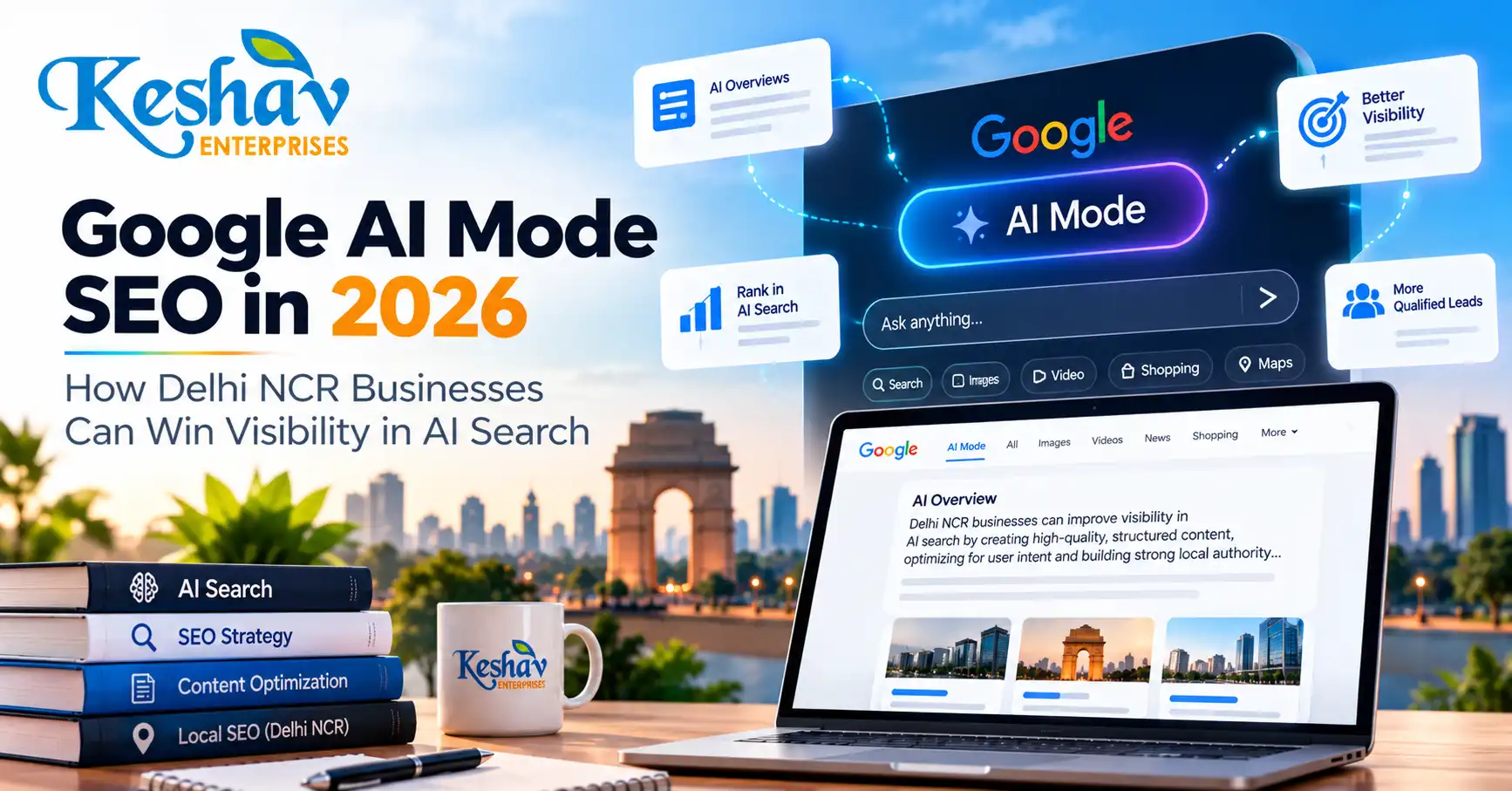
Google AI Mode SEO in 2026 is not a separate trick or a new type of markup. For businesses in Delhi NCR, the strongest approach is still to build technically accessible pages, publish original and useful answers, make the business entity clear, connect related pages with sensible internal links, and measure whether search visibility produces qualified enquiries.
The difference in 2026 is that more users are asking longer, more conversational and comparison-heavy questions inside Google Search. AI Overviews and AI Mode can surface supporting links from pages that answer different parts of those questions. That creates an opportunity for businesses that explain their services clearly instead of publishing repetitive keyword pages.
This guide explains what has actually changed, what Google currently recommends, how local businesses should adapt, and how to measure AI-search visibility without relying on unsupported promises.
Quick answer: how do you optimize for Google AI Mode in 2026?
To improve your eligibility for Google AI Mode and AI Overviews, make sure important pages are crawlable and indexable, answer real customer questions directly, publish unique evidence-based content, use descriptive internal links, keep business information consistent, and make important text available in the page content. Google states that its existing SEO best practices continue to apply to AI features and that there is no special AI-specific schema required.
Google’s current guidance is available in its AI features and your website documentation.
What changed in Google AI search during 2026?
Google has continued expanding guidance and measurement around generative search. In May 2026, Google published a new resource focused specifically on optimizing for generative AI experiences while reiterating that useful, original content and normal SEO fundamentals remain the foundation. In June 2026, Google introduced dedicated Search Generative AI performance reporting, and Google stated that these insights had rolled out worldwide by August 31, 2026.
That means businesses can now approach AI search with better measurement than before. Instead of treating “AI visibility” as a vague agency metric, teams can increasingly connect search visibility with actual impressions, visits, engagement and conversions.
See Google’s 2026 generative AI optimization resource announcement and its Search Generative AI performance reporting announcement.
AI Mode SEO vs traditional SEO: what is different?
| Area | Traditional search | AI-assisted search | What businesses should do |
|---|---|---|---|
| Queries | Often shorter and keyword-led | More conversational, multi-step and comparative | Answer complete questions and decision points |
| Discovery | Classic search results and rich features | Generated answers with supporting sources | Create pages that are useful as standalone sources |
| Content depth | One page may target one main topic | Different pages may support different sub-questions | Build focused topic clusters instead of duplicate pages |
| Technical eligibility | Pages need to be crawlable and indexable | The same requirement still applies | Fix rendering, canonical, sitemap and robots issues first |
| Measurement | Clicks, impressions, rankings and leads | Dedicated generative AI visibility is increasingly measurable | Connect visibility with qualified business outcomes |
1. Start with indexability before thinking about AI visibility
A page that Google cannot crawl or index is not a strong candidate for AI-assisted visibility either. This is especially important for businesses using React, Next.js or headless WordPress.
- The public URL returns HTTP 200.
- The main text is available reliably to crawlers.
- The canonical points to the intended public URL.
- There is no accidental
noindex. - Robots rules do not block required crawling.
- The page appears in the correct sitemap.
- The page is linked internally from relevant sections.
- The visible title, headings and metadata describe the same topic.
If your current website has technical or rendering problems, start with a website development and technical review before scaling content production.
2. Build content around complete customer questions
AI-assisted search is useful for queries that previously required several separate searches. A business owner might ask:
- “Should I invest in SEO or Google Ads first for a new clinic in Delhi?”
- “How do I improve Google Maps visibility without creating fake location pages?”
- “Why is my React website indexed slowly even though the WordPress backend has published posts?”
- “What should I check before hiring an SEO company in Delhi NCR?”
These are not just keywords. They are decisions. Strong content explains the trade-offs, gives a direct answer early, then expands with examples, limitations and the next action.
3. Avoid publishing five pages that answer the same question
One of the easiest ways to weaken a content strategy is to create multiple near-duplicate articles around the same intent. Instead, build a topic cluster in which each page has a distinct purpose:
- A core SEO services page for commercial intent.
- A practical AI Mode guide for emerging search behavior.
- A local SEO guide for map and location-based discovery.
- A technical indexing guide for React, Next.js and WordPress sites.
- A comparison article when users need to choose between SEO and paid acquisition.
4. Strengthen entity clarity
AI systems and customers both benefit from consistent information about who the business is, what it offers, where it operates and how people can contact it.
- Keep company name, services and contact details consistent.
- Explain which markets are genuinely served.
- Use real project examples only when they can be verified.
- Clarify what is included and excluded in each service.
- Support technical claims with primary sources.
5. Use clear answer-first writing for AEO and AI retrieval
A useful section should still make sense when extracted from the rest of the article. A practical structure is:
- Question-based heading.
- Two- or three-sentence direct answer.
- Supporting explanation.
- Example or comparison.
- Relevant internal link or next action.
6. Create original information that deserves to be cited
Google’s guidance for AI search emphasizes unique, valuable content rather than commodity text. Useful original value can include:
- Actual service process.
- Real technical checklists used during delivery.
- Original diagrams or screenshots.
- Clear comparisons between options.
- Common implementation mistakes.
- Verified project examples when permission exists.
Do not invent case studies, testimonials, traffic increases or client results just to make an article look authoritative.
7. Support text with useful images and visuals
Google’s AI-search guidance recommends supporting textual content with high-quality images and video where appropriate. A strong featured image should match the article rather than being reused across unrelated posts.
- Create a unique visual for the article topic.
- Use a descriptive filename.
- Add meaningful alt text.
- Compress the asset for web performance.
- Avoid keyword stuffing in alt text.
8. Treat local SEO as part of AI discovery
Local businesses still need accurate business information, genuine reviews, appropriate service-area content and a useful Google Business Profile. AI search does not replace these fundamentals.
For a deeper local strategy, read the Local SEO for Delhi Businesses guide or explore local SEO services in Delhi NCR.
9. Use structured data to clarify content, not to “hack” AI search
Structured data can help search systems understand content, but it must accurately match what users can see. Google states that there is no special AI-specific schema required for AI Overviews or AI Mode.
10. Measure AI-search visibility with real business metrics
In 2026, measurement is becoming more useful because Search Console now provides dedicated generative AI visibility reporting. Track:
- Generative AI impressions where available.
- Organic landing-page clicks.
- Qualified enquiries.
- Conversion rate by landing page.
- Search queries with commercial or problem-solving intent.
- Pages gaining impressions but weak CTR.
- Pages that remain unindexed after publication.
11. Build internal links that reflect topic relationships
Internal links should help a reader continue the journey. Use descriptive anchors and avoid linking the same commercial keyword repeatedly across every article.
12. Improve conversion experience after the click
More visibility is not useful if a visitor cannot understand what to do next. Every high-intent page should make the next step obvious through mobile readability, clear service scope, trust-building information, visible enquiry options and simple forms.
A 30-day Google AI Mode SEO action plan
Week 1: technical and indexing audit
- Check status codes, canonical tags and robots directives.
- Review sitemap coverage.
- Inspect important URLs in Search Console.
- Test rendered content on JavaScript-heavy pages.
Week 2: improve commercial pages
- Rewrite vague introductions.
- Add direct answers to common buying questions.
- Clarify service scope and locations served.
- Improve CTA placement.
Week 3: publish one genuinely distinct guide
- Choose a question customers actually ask.
- Use primary sources where factual claims matter.
- Create a unique topic-specific image.
- Link to related service and educational pages.
Week 4: measure and refine
- Review Search Console performance.
- Check generative AI visibility where available.
- Identify low-CTR pages.
- Review indexing issues.
Frequently asked questions
Is Google AI Mode SEO different from normal SEO?
The fundamentals are largely the same. The practical difference is that users are asking more complex questions, so content should answer complete problems rather than only target short keywords.
Do I need special schema for Google AI Mode?
No. Google says there is no special schema.org markup required for AI Overviews or AI Mode.
Can a small Delhi business appear in AI Overviews?
Potentially, yes. Eligibility depends on the page being indexed and eligible for Google Search with a snippet. Inclusion is not guaranteed.
Does AI Mode use only pages ranking in the top 10?
Google does not describe AI Mode as simply copying the classic top ten results. AI features can use related searches and supporting sources across subtopics.
How should I measure AI search traffic?
Use Search Console’s generative AI visibility reporting where available, combine it with normal Search performance, and track enquiries, engagement and conversions.
Can AI-generated content rank?
The important issue is quality, originality and usefulness rather than whether a tool assisted with drafting.
Do local SEO and AI SEO work together?
Yes. Accurate local information, relevant service pages, genuine reviews and strong local content can support overall search understanding.
Should every service page mention “AI SEO”?
No. Add AI-search information only where it helps the reader.
What should I fix first if my website has weak AI visibility?
Start with crawlability, indexability and content quality.
How can Keshav Enterprises help?
Keshav Enterprises can review technical SEO, content structure, local SEO, React/Next.js implementation and conversion flow for businesses across Delhi NCR.
Final takeaway
Google AI Mode SEO in 2026 is best treated as an evolution of search, not a replacement for SEO fundamentals. Businesses that make their websites technically reliable, publish original decision-support content, maintain clear entity information and measure real outcomes are in a stronger position across classic search and AI-assisted search.
If you want a practical review of your current website, contact Keshav Enterprises with your website, target services and priority markets.